Manhattan Neighborhood Network TV Bootcamp

In mid-November I finished up the Manhattan Neighborhood Network’s (MNN) “Creating a TV Show Bootcamp.” The class is 4-week intensive teaching students how to use studio equipment and edit on Adobe Premiere Pro. The class culminates with a final capstone project of a 3–7-minute episode applying and demonstrating your knowledge. Let’s Write About has been on the network, but I wanted to take the next step to use the studio spaces of the network and better familiarize myself with a professional production.

Gray brick entrance to the Manhattan Neighborhood Network.

The class was really wonderful! It was a smaller size than usual due to COVID restrictions, so we had 5 students total while typically there are 12 students per class. This smaller size meant that in our studio practices we were always on a piece of equipment, giving us a truly hands-on learning experience. I was always working on either a camera, the control panel and switcher, the audio board, or being the talent in front of the camera which was also a cool perspective. Filming in front of my phone and filming in front of four professional cameras with studio lights on and around me are two vastly different experiences.

I was thankful for all the practice and repetition. I was pretty nervous about working on the equipment at first, especially the cameras. I have little to no experience in a studio setting and this is some expensive, high-end stuff. But with practice and supervision, the roles came easily enough. It’s also helpful to know that the studio has facilitators who are studio professionals employed by MNN to do most of the technical work and set-up of the equipment itself, so community producers and their crews are really doing the specific work of moving the camera, focusing them, setting up mics and getting levels on audio, and directing/switching on the control panel.

Cameras arranged in a professional TV studio.

On the software end, I came in with a fair understanding of Adobe Premier. However, I really just threw myself into it to make video content over the lockdown and subsequent job freeze, so it felt nice to take a big step back and get a full rundown of the basics of the program. Our instructor also took time to teach us her organizational strategy and gaining that insight from a media professional has already made my workflow so much better. Honestly, my workstation and cataloging were a bit (read: irredeemably) messy, mainly because I couldn’t conceive of a better system. As usually is the case, the simplest solution is the best and taking the time to rethink my set up with a clear model has made my editing flow smoother.

The final project was a cool opportunity to test the capacity of the studio. I decided to bring my collaborator Frankie into the studio with her partner and puppeteer Jim!

The project gave us an excuse to consistently rehearse together and also gave me an excuse to make my first official script rundown. Previously, Let’s Write About episodes involved me doing all the puppeteering with voice acting work from Frankie and other collaborators. In part because the show began during the COVID-19 lockdown and in part because filming more than one person or figure with a phone camera can be difficult, especially in an apartment without the space to arrange or rearrange a set. This change felt markedly different, the studio space and resources gave us the room to easily act together, delivering a more polished and professional performance which I’m excited to bring into all our future episodes.

Three actors in a TV Studio

Another thing I wanted to try out was playing music through the studio itself. Previously I would start and stop the music on my laptop, over-filming to later edit my movements, and then Dane would adjust the audio and layer over the song in his audio post-production work. Now, the music can be seamlessly recorded at the same time we, in the studio, hear it live. It sounds small, but from a production/stress consideration it’s huge! No more stopping and starting or going back and forth. While the cueing will take a bit of practice, this first run through of it for the final project was wonderful and promising for what’s to come.

Finally, when we film our episodes, we’ll be able to arrange the lights and make use of the green screen in the studio! These are roles facilitators cover since they require quite a bit time, knowledge, and ladder climbing, but I’m looking forward to playing with some professional green screening after my early DIY attempts with Space Cacti episodes.

If you’re considering making some TV or even just curious about what the process is like, I highly recommend the class! MNN also offers a range of other courses for beginners and experts alike, so check those out too!

And, of course, stay tuned for more Let’s Write About!

An ornate paper certificate from the Manhattan Neighborhood Network

A certificate of completion from the Manhattan Neighborhood Network for Donnie Welch for the Creating a TV Show Bootcamp with ornate border, signature, and sticker.

Screen Play: Modeling Pretend Play on Screen

Originally Posted on the Accessible Festivals Blog

Let’s Write About is an inclusive, born-accessible children’s show exploring social-emotional themes through creative writing and inspiring inquiry-based learning with sensory activities that kids of all abilities can do at home. The show pulls from my work as a teaching artist and began as a way to create more accessible asynchronous content for virtual learning. In each episode, there’s a multi-sensory writing prompt and rhythm, song, and movement are used as entryways to literacy.

As an educator, I consider play central to learning and development. One challenge for me in first writing and filming Let’s Write About was to figure out how to best model and promote pretend play in an asynchronous setting.

Like many children’s shows, Let’s Write About uses puppets. For one of the puppet character sets, the Space Cacti, I film myself using them like figures or toys I’m playing with rather than hand puppets. In their scenes, my hands are clearly in the shot, moving the characters around and manipulating them for speaking parts. Filming this way gives me the vantage point to, in the words of Stanley Greenspan and Serena Wieder, “speak not for yourself but for the doll. Become the doll and show the child how to enter the make-believe world. This introduces her to new ideas and symbolic constructs.” Unlike characters such as Dragon and Queen Cumulonimbus who children see me on screen speaking to, the Space Cacti are always, well, in space. The far reaches of space comprise the make-believe world (or worlds really) I’m inviting the viewer into. 

When acting out the Space Cacti, I’m encouraging viewers to play along or engage in their own play. I’m doing so not only because play itself is important, but because pretend play is a building block of language:

When we use symbols, we use something to stand for something else. In the case of pretend play, children may use one object to stand for another, such as pretending a spoon is a hairbrush, or a tablecloth is a cape. This type of symbolic thought is also needed for language, as our words are symbols. Our words stand for our thoughts and ideas. Therefore, pretend play and language both involve the same underlying ability to represent things symbolically (Weitzman and Greenberg, 2002).

As an educational, literacy-based show it’s crucial for Let’s Write About to address and build on these foundational, pre-literacy skills. There are no specific pretend play scenes, like there are writing and sensory craft sequences, but instead the skits showcase play without getting pedantic. Play should be playful and attempting to teach or inspire it any other way would be counterintuitive. My goal in these skits is to model the joy of improvising and using your imagination by simply having fun myself. 

For now, Barrel, Prickly, and Dr. Panda are in charge of the play department, but as the show develops perhaps some new characters will join in!

View the Space Cacti in action in “Let’s Write About World Building” 

Compare the performance with my interaction with Dragon in “Let’s Write About Dinosaurs”

  1. Greenspan, S. I., & Wieder, S. (2009). Engaging autism: Using the Floortime Approach to Help Children Relate, Communicate, and Think. Da Capo Lifelong Books.

  2. http://www.hanen.org/Helpful-Info/Articles/The-Land-of-Make-Believe.aspx

Yes by Frankie Ann Marcille

Today I wanted give a little review of the book “Yes” The Story of a Dreamer.

Picture book cover. A realistic illustration of an older man in overalls sitting on a bench with a young girl in a ballerina outfit. The two are looking at one another and smiling.

Published by Leaning Rock Press in 2021, Yes is written by Frankie Ann Marcille and Illustrated by Patrick Regan.

“When I was a little girl, I had many wonderful dreams. I dreamt of dancing across glorious stages for crowds of people. I dreamt of traveling the world. I dreamt of becoming a teacher, sharing my experiences with the next generation of dreamers. When I was a little girl, after a night of dreaming, I would spring from my bed excited to share my dreams with anyone who would listen. But as I shared my dreams, I noticed something that made my heart sink. People began to frown. People exchanged worried glances. People told me, “no”. And then I met someone who told me, ‘Yes, you can do anything!” and my life was changed forever.” via Leaning Rock Press

In the interest of full disclosure, this book is by a friend of mine and colleague on the Let’s Write About team, but if I didn’t believe in it, I wouldn’t be writing about.

The story pulls on Marcille’s lived experience to share a tender and self-affirming story of a young blind girl finding the strength to live her dreams. The story itself is lovely, well-written, and flexes Marcille’s literary muscles as a first time author.

I find myself rarely a fan of realism in picture book illustration, I gravitate more towards the cartoonish and highly illustrated, but Regan’s illustrations fit the tone of the Marcille’s text so wonderfully that I can’t imagine anything in their place. Furthermore, the design note of having each illustration framed in small circles works both aesthetically and metaphorically. It was a brave choice, as publishers often want full spread work, but there’s a quietness to this text that the framing enhances.

Picture book spread with realistic illustrations. The illustration on the left shows a little girl looking down shyly beside a pair of legs in jeans. The picture on the right shows the little girl standing next to an older man dressed like a gardene…

What I love most about this story is that it doesn’t pull punches. Marcille is sharing a lived experience with her readers and being real about challenges and judgements that come up in life. The world is full of jerks. But the world is also full of “Gardeners,” the kind of folks who help you grow. The character of the Gardener is a favorite of mine on a metaphoric level because the protagonist has everything she needs to bloom, she just needs a little water (or in this case, a star) to help her along.

In a book about imagination and dreams, I appreciate the leap of the Gardener having an actual star because, well, why not? I find the star symbolic of all the little kindnesses in the world that people like the Gardener have to offer, and the fact that it’s a literal star in the text is all the more fun for young readers!

The dialogue of the Gardener is another favorite point of mine. Here we find Marcille’s voice as an adult and, importantly, as an educator and artist. Someone who doesn’t mince words. The Gardener isn’t afraid to tell the young protagonist that the people doubting her:

“They’re wrong,” he said.

Which is an important lesson. Sometimes folks are worthy of our empathy and the benefit of the doubt, and sometimes they’re straight up just wrong.

A lesson we later read the protagonist passing onto her own students and “the next generation of dreamers.”

Picture page with illustration and text. The illustration is a realistic watercolor style image of an older man handing a shining start to a little girl. The text is aligned below and “They’re wrong, he said.” is in a bold typeface.

If you’re looking for a classroom text that celebrates disability through the lens of personal triumphs and the little victories that make life sweet, then I highly recommend “Yes!”

The story can be bought via Frankie’s website: https://www.frankieannmarcille.com/shop

Marcille and Regan are also offering virtual and in-person school visits and I believe Marcille is hard at work on making an audio book edition as well.


Images used with permission from the author.

Open Studio for All Fall-Winter 2021

The next session of Open Studio for All is live! We’re starting things back up this Saturday.

Open Studio is a community art making series my colleague Tanya and I started to offer a creative space during the 2020 lockdown for folks of all abilities. You can listen to us talk about it on the Affect Autism podcast. We’re continuing to offer it, though now on a monthly basis, since the sessions last year created a tight knit group of creators.

In the sessions everyone, Tanya and I included, make art, do some writing, or just simply hang out while we listen to a collaborative playlist. Please note, this isn’t a class with instruction, but is instead an open-ended community group. There’s no pressure to create, so if you’re just looking for a space to hangout and chat, come on in! There’s also no pressure to commit, this group is a drop-in format.

View the flyer below and email me DonnieWelchPoetry [at] gmail.com for more information and to receive the Zoom login!

Promotional Flyer for "Open Studio for All" with red paint backdrop. Blue text situated on an off white square reads:COME MAKE ART, WRITE, AND BE PARTOF A VIRTUAL CREATIVE COMMUNITY!GROUPS WILL MEET ON ZOOM1:00PM - 2:00PM (EASTERN TIME)September 18t…

Wordplay with the Kennedy Center

Through winter and spring I was working with the Kennedy Center Education on a video for their Teaching Artists Present series.

Working with them was a blast, so I was delighted when they asked if I’d be interested in presenting at their Art’s Integration Conference.

The Kennedy Center’s Arts Integration Conference: Exploring an Approach to Teaching explores the how of arts integration, rooted in the Kennedy Center’s 40 years of experience in professional learning for teachers. It provides many strategies that can make arts integration a part of every teacher’s approach to teaching. The conference is appropriate for teachers, principals, school district administrators, and partnering arts organization staff and teaching artists.
— kennedy-center.org/education/networks-conferences-and-research/conferences-and-events/arts-integration-conference/
Brightly designed flyer cover for the The Kennedy Center’s 2021 Arts Integration Conference: Exploring an Approach to Teaching June 28- June 30.

My presentation “Wordplay: Combining Sensory Play with Poetry” took this concept of an “approach” to heart and distilled my rationale and strategies for integrating sensory work with poetry into a 90-minute, interactive workshop.

The interactive piece for the presentation admittedly took me a bit to get right. My past virtual presentations have been predominantly lecture and anecdote driven webinars and I kind of defaulted to that as I was putting “Wordplay” together. The Kennedy Center organizers carved out time to meet with me for a dress rehearsal and let me run and rework my presentation again and again. Their thoughtful critiques and feedback helped me shape it away from a lecture and into a true workshop. I’m sure they had a lot going on from the organization side of the things, but they still made time for me as a presenter and I can’t thank or praise them enough!

I presented twice, which was really nice because time flew the first time through and I was able to be a bit more minute conscious the second time around. I had a model workshop as one of the central components of “Wordplay” and typically when I do model workshops in conference spaces it takes a bit to warm the room (especially the Zoom room) and get people invested in sharing their work. These presentations felt more like running workshops in a community setting, as if everyone came ready to write some poetry. Even in my larger group people weren’t shy, more people than I could get to wanted to share their artwork and poetry!

A conference schedule laid out with a purple background and itinerary in blue bars with white font showing “Arts Integration Sessions” for the day with a side bar categorizing sessions by grade level.

In both presentations I had to skip over an example of an asynchronous multi-sensory lesson. I left it in the resources for attendees to access and decided to embed it here as well because I’m really quite proud of how it turned out. If you watch it, remember to ask yourself: what senses are being activated?

One thing I really loved about this conference is that each presenter had a Kennedy Center staff member as a co-facilitator to manage the technical end of the presentation: breakout rooms, polls, caption access, technical difficulties, and the like. This is always such a relief! I prefer, and usually ask for, a co-facilitator anytime I work in Zoom, Teams, or a similar video platform because trying to teach and tech at the same time can be a lot.

My session ended with breakout rooms where educators worked in small groups to create multi-sensory lessons for poems. I was able to freely float between the rooms while the technical side was handled and focus on guiding the small group discussions and plans. The lessons all the educators came up with were marvelous! A few of them I might just have to keep in my bag of tricks too.

Things were a bit hectic for me personally and professionally in June so I didn’t make it to any other presentations. I did, however, carve out some time to watch the Virtual Field trip Leonardo and Sam

Conference schedule showing “Virtual Field Trip: Mo Willem’s Leonardo & Sam” designed with a purple background and theme.

The work Manual Cinema does is astounding. Highly recommend this if you have an opportunity to view. Their work with props definitely inspired me to try some new puppet and backdrop ideas in Let’s Write About.

All in all, the Kennedy Center’s Arts Integration Conference was a wonderful event to be a part of! The work of the Kennedy Center staff made the conference the most seamless virtual experience I’ve had in a conference space and the energy of it was like a live workshop, a trick that’s hard to pull off this deep into virtual learning when so many educators (myself included) are feeling a bit Zoomed out. If you have an opportunity to go (virtual or live) in the future I definitely say do it!

New Let's Write About Writer and Cast Member

Frankie Ann Marcille Joins LET’S WRITE ABOUT

Blind author, educator, and advocate joins cast and writing team of inclusive children’s show.

New York, New York: On Saturday June 12th, 2021, Frankie Ann Marcille will make her writing and voice acting debut in Let’s Write About on Manhattan Neighborhood Network’s Channel 1.

Let’s Write About is an inclusive children’s arts and education show with a born-accessible approach to production. The show considers varying audience experiences from pre-production to release and integrates audio descriptions, American Sign Language, and captioning into each episode.

Frankie Ann Marcille is a legally blind author, educator, and advocate living in Manhattan. Over the past decade, Frankie Ann has traveled the country teaching and advocating for individuals of all ages with multiple disabilities. She has also joined the team at Elle Jones Casting Company as a Casting Associate and Accessibility Specialist, recruiting talent with disabilities for film/television while advocating for accessibility on set. Her children’s book Yes: The Story of a Dreamer was published this year by Leaning Rock Press. Welch and Marcille have previously worked together as educators in a day school setting.

Donnie Welch, creator and producer of Let’s Write About said of the new partnership “Having taught together I know the educational goals and principles of inclusion will be in safe hands in the writing room. Already our drafting and scripting together has yielded creative new characters and topics. I’m excited to see where we go from here!”

On the topic of inclusion Welch added, “Let’s Write About is written and produced for kids of all abilities and in order to really meet that goal, I need to bring in creators of all abilities and experiences. I know Frankie’s expertise as advocate, teacher, and writer is going to make every episode not only better, but more representative of the blind and low vision community.”

“I have always been a huge admirer of the work Donnie does as both an artist and educator.” said Marcille when asked about partnering with Welch. “He supports young people of all abilities to express themselves in a way that is meaningful and accessible. Let’s Write About is a beautiful representation of that, and I couldn’t be more excited to join the team! I am especially excited to be working alongside Donnie again, and I am hoping that we can create content together that truly resonates with our audiences, helping them to channel their creative energy around relevant social emotional themes.”

Catch Frankie’s debut in “Let’s Write About Routines” Saturday 6/12 at 9:00am on the Manhattan Neighborhood Networks Channel 1

Viewers without cable or outside Manhattan can live stream from the MNN site on the dates and times listed using the link: https://www.mnn.org/watch/channels/community-channel-1


About Let’s Write About: Let’s Write About is an inclusive, born-accessible children’s educational show exploring social-emotional themes through creative writing and inspiring inquiry-based learning with movement and sensory activities kids of all abilities can do at home. A fiscally sponsored project of the 501(c)(3) non-profit Accessible Festivals, the show carries on their sponsor’s mission by creating quality, accessible educational television.

About Frankie Ann Marcille: (she.her) is a legally blind author, educator, and advocate from southeastern Connecticut, currently residing in Manhattan, New York. At three months old, she was diagnosed with septo-optic dysplasia; a condition that resulted in legal blindness. She earned her BA in Theatre Arts from Western Connecticut State University and is currently studying to obtain her master’s degree and dual certification in Vision Rehabilitation Therapy/Orientation and Mobility from Hunter College. Frankie Ann has been working as a contract remote educator for the Utah School for the Blind. She has also joined the team at Elle Jones Casting Company as a Casting Associate and Accessibility Specialist, recruiting talent with disabilities for film/television while advocating for accessibility on set. To learn more about Frankie Ann, you can visit her website: frankieannmarcille.com and email [email protected]

About Manhattan Neighborhood Network: [via Website] “Established in 1992, Manhattan Neighborhood Network (MNN) is a media learning, production, and distribution hub that promotes creative expression, independent voices and community engagement. We operate two state-of-the-art media production and education facilities in Manhattan and run Manhattan's public access TV channels, reaching some 500,000 cable subscribers in the borough.”

Press release in white text against a black frame, text is bordered with pink and yellow lines. Text from graphic is same as typed above.

Kennedy Center Teaching Artist Present Video

My video with the Kennedy Center Education’s Teaching Artist Present series is out. It’s really wonderful to be included with so many amazing teaching artists from all over the country!

My video focuses on slowing down and using your senses to write a poem about where ever you happen to be right now. It’s been a hectic, sorrowful, stressful year, so I wanted to create a resource that would help young poets find the space to express themselves and reflect. In my own practice, I find that making space starts with defining so that’s what I teach in this asynchronous video.

Grab a notebook and enjoy!

O, Miami Poetry Coalition: Mangrove Poetry

Over the Fall and Winter of 2020-2021 my colleague Raquel Quinones and I worked with O, Miami’s Sunroom, a poets in schools program, with poets from Brucie Ball where we had previously worked with festival in 2019 and led a teacher training as a part of their virtual 2020 festival

After our Sunroom series finished, O, Miami approached us with an opportunity to work with them on their Poetry Coalition project.

I had never heard of the Poetry Coalition before but I came to learn that it’s overseen by the Academy of American Poets and is

[A] national alliance of more than 25 organizations dedicated to working together to promote the value poets bring to our culture and the important contribution poetry makes in the lives of people of all ages and backgrounds. Members are nonprofit organizations whose primary mission is to promote poets and poetry, and/or multi-genre literary organizations that serve poets in the disability community and of specific racial, ethnic, or gender identities, backgrounds, or communities. [https://poets.org/academy-american-poets/poetry-coalition]

This year’s theme is “It is burning./ It is dreaming./ It is waking up.: Poetry & Environmental Justice” with the goal being to:

demonstrate how poetry can positively provoke questions in their communities about environmental justice and spark increased engagement with this urgent topic.  [https://poets.org/poetry-coalition-theme-march-2021]

With that in mind, O,Miami asked Raquel and I if we would be interested in teaming up with a long time partner of theirs, the Marjory Stoneman Douglas Biscayne Nature Center on a project combining nature and poetry.

I thought of the Ceramic Stories projects I typically run over the summer in community gardens with the New York Restoration Project and detailed that work while brainstorming how it could be applied

1. Virtually

2. To the Miami Community

Living in uptown, Manhattan costal reclamation is big environmental concern and something I’m aware of because of my environmental work as NYC Parks Steward. I brought up the idea of costal resiliency as well as native and invasive species and we began imagining a lesson where participants paint pots, then plant mangroves in them to later be planted outside in their natural environment. In that way they could learn about some important local flora and take an active role in protecting their community from the effects of climate change.

After a Zoom meeting with all the parties, we had our imagined lesson planned out concretely. Now, step one in the process was Raquel and I making a social story to be sent home. If you’re unfamiliar with a social story, I invite you visit a blog I wrote which shares an example story from one of my Bronx Museum partnerships. Since this was going to be such a long project and it’s easy for things to get misinterpreted or misunderstood virtually, I wanted to make sure each student and family had a clear idea of what we would be doing each workshop.

Once this story was sent out with the needed planting supplies we were set to go!

The first session went really well! Everyone had their four panel story board included with the materials sent home and was really excited about the opportunity to draw. Most of our role was reminding the poets that these would be painted onto a pot as the next step, so to be mindful about not putting too much tiny detail or dialogue into them. These drawings needed to be something fairly easy to replicate.

Our sessions were interrupted by the district’s Spring Break. Over the break we asked the poets to trace their finished stories onto the pots so that way we could focus on painting together for our next session.

In support of this, I filmed an asynchronous video lesson of tracing my story onto my pot. It proved really difficult to get the pencil markings to show up on camera, but I tried to keep the instruction explicit to help guide the poets through the process.

Everyone came back from break with their pots traced and ready to go! In person, the tracing and prep is often the most difficult part, so having that done ahead of time with the asynchronous instruction made this workshop smooth sailing!

In fact, the painting lesson was really a kind of ideal moment of virtual instruction as co-regulation. Everyone was just together in the space, focused on their work and enjoying one another’s company. It was honestly, probably one of the most successful virtual sessions I’ve had in terms of community building and presence.

The next lesson we took a break from our pots to explore the plants themselves and write some poetry.

We started with each poet taking a turn reading the poem Mangroves by Zelda Quakawoot. I especially love this poem as a kind of mentor-text because it moves through all the senses and that’s how I wanted the poets to describe and write about their plants.

Since everyone had just received their mangrove seedling over the week, Nhung Nguyen from the Nature Center led a brief introduction to Florida mangroves to give some background.

After that, as a workshop we created a word bank for each of the five senses. We ran out of time, so the word bank was sent out to each student to create a poem on their own. Below is mine which makes use of our group’s descriptive, sensory, terms and words.

My Mangrove is like slug

wooshing in the music of the wind.

It doesn’t feel slimy though,

it feels crusty and mucky and ouch!

...and pinchy.

I don’t smell much,

but there is an earthy taste

in my mouth.

For our last session, everyone needed to put the plants into their pots!

I thought we’d start by first sharing our poems, but everyone came so prepared and excited to plant that I made the call to go right into the planting!

This session was mainly led by Nhung from the Nature Center with Raquel and I supporting since she had the expertise. Much like the painting session, it was a really wonderful virtual session where all the poets were super curious, engaged, and in community. Once everyone had finished planting, we had some time at the end to share their planting experiences, painted pots (once again), and poems.

The goodbye was incredibly bittersweet! But, as one of the teachers pointed out, we sing, “we’ll see you again next time” so I’m really looking forward to the next chance I have to work with these poets.

Manhattan Times Write Up

Excited to share a recent write up from my neighborhood weekly The Manhattan Times. I’ve copied the body of the article here for convenience, but you can head to their page to read it in context with photos. Click this link to head to the article!

Power Prose

By Sherry Mazzocchi

Play + poetry = power.

Inwood resident Donnie Welch’s new TV show, Let’s Write About, premieres April 10th on the Manhattan Neighborhood Network (MNN). With a pinch of Mr. Rogers and a dash of Bill Nye, the show is aimed at young children of all abilities.

Each episode’s theme is designed to inspire writing and poetry.

Welch filmed The Let’s Write About Food episode in his mint-green kitchen. Children learn to make dough, discover fractions, acquire problem solving skills, and use food as a subject for poems. Songs and movement are peppered throughout the 28-minute show.

“Rhythm helps us understand poetry,” Welch said. “It’s such an important aspect of writing poetry and verse.”

Scenes are visually described. Sign language interpreter Miriam Lerner narrates the dialogue. Visual and audio descriptions not only make the show more accessible, it also reinforces learning for children still developing reading and vocabulary skills.

Welch said the additional descriptive layers serve still another purpose.

“I believe that inclusion really benefits everybody,” he said. “Showing the different ways that people communicate is only going to make kids and viewers more empathic peers in schools and neighborhoods.”

Creativity and self-expression are foundational skills, Welch said. “I want to create space where it’s okay to just practice writing or practice speaking or vocalizing. The more you practice it, the more confident you get in your own voice.”

Poetry is powerful, he added.

“Poetry is one way that I as a writer share my inner world. It’s a tool that I have. And I want to give that same tool to the students I work with.” Tools for self-expression also leads to self-advocacy, a life-long skill.

Before embarking on a TV career, Welch worked at The Rebecca School, a school for children with neurodevelopmental delays. There he blended an interest in disability justice and love of poems. Eventually he created a full curriculum involving creative writing and poetry. As a teaching artist, he’s partnered with the likes of The Bronx Museum of the Arts, the New York Public Library and other community organizations.

The genesis for the TV show grew out of Zoom classes. “It’s meant for students to watch on their own,” he said. He also offers free educational content for teachers and parents to use along with the episodes.

Welch has worked as a teaching artist.

One of the upcoming shows discusses creating new worlds with science fiction and fantasy stories. Still another talks about routines and how they can change.

“Everything that has happened has really shaken up routines for adults, but especially for kids,” he said. “That can be something really disruptive, and especially for young children that might not have the language to speak yet.”

Let’s Write About is a simple concept with lofty goals. Welch wants to raise production values and ultimately add a Spanish language component to the show. “I’m focused on making each episode better and better.”

Let’s Write About Airing on Manhattan Neighborhood Network

Inclusive children’s show makes its way from YouTube to TV

IMG: Yellow squiggle frames heading LWA on MNN, white font describes "Now, you can watch Let’s Write About on the Manhattan Neighborhood Network! Tune into Channel 1 Stream Online mnn.org/watch/channels/community-channel" Below a colorful antique TV…

New York, New York: On Saturday March 13, 2021, Let’s Write About began airing on Manhattan Neighborhood Network’s Channel 1. Let’s Write About is an inclusive children’s arts and education show with a born-accessible approach to production. The show considers varying audience experiences from pre-production to release and integrates audio descriptions, American Sign Language, and open captions into each episode. Manhattan Neighborhood Network (MNN) operates the borough’s public access television channels which, per their website, are “reaching some 500,000 cable subscribers in the borough.” The show was accepted as part of the station’s Spring Quarter running from March through June and will air once a month.

Upcoming air dates for Let’s Write About:

Saturday 4/10 at 9:00am

Saturday 5/08 at 9:00am

Saturday 6/12 at 9:00am

Viewers without cable or outside Manhattan can live stream from the MNN site on the dates and times listed using the link: https://www.mnn.org/watch/channels/community-channel-1

Following the news Donnie Welch, creator and producer of Let’s Write About, said, “Saturday morning is such an exciting time for the show, maybe poetry can become as much a part of Saturday mornings as cereal! I’m looking forward to the show reaching a new audience. Virtual learning has shown that not all families in the city have equitable access to internet. I hope the show can now reach kids who might not be able to access it online.” Welch plans to continue submitting Let’s Write About to future quarterly programming windows at MNN.

About Let’s Write About: Let’s Write About is an inclusive, born-accessible children’s show exploring social-emotional themes through writing and inspiring inquiry-based learning with movement and sensory activities kids of all abilities can do at home. A fiscally sponsored project of the 501(c)(3) non-profit Accessible Festivals, the show carries on their sponsor’s mission by creating quality, accessible educational television.

#InternationalDayofPeoplewithDisabilities Video

On today, Dec. 3rd I joined a group of advocates and self-advocates to talk about the importance of web accessibility. Thanks to AcessiBe for bringing us together! Check out the short promo video and, as always, make sure to caption, alt-text, and audio describe your media!

In this video, we turned to accessibility advocates to understand why is web accessibility important? Full transcript: https://bit.ly/33EBT1kWeb accessibilit...

Incite/Insight

I wrote about my work with neurodivergent students as an educator with the Bronx Museum of the Arts for Incite/Insight The American Alliance for Theatre & Education's online journal. Thanks to editors Alex Ates & Carolyn Marie Wright for their careful attention & work on this piece!

Click here to read the article

Art App Community Class

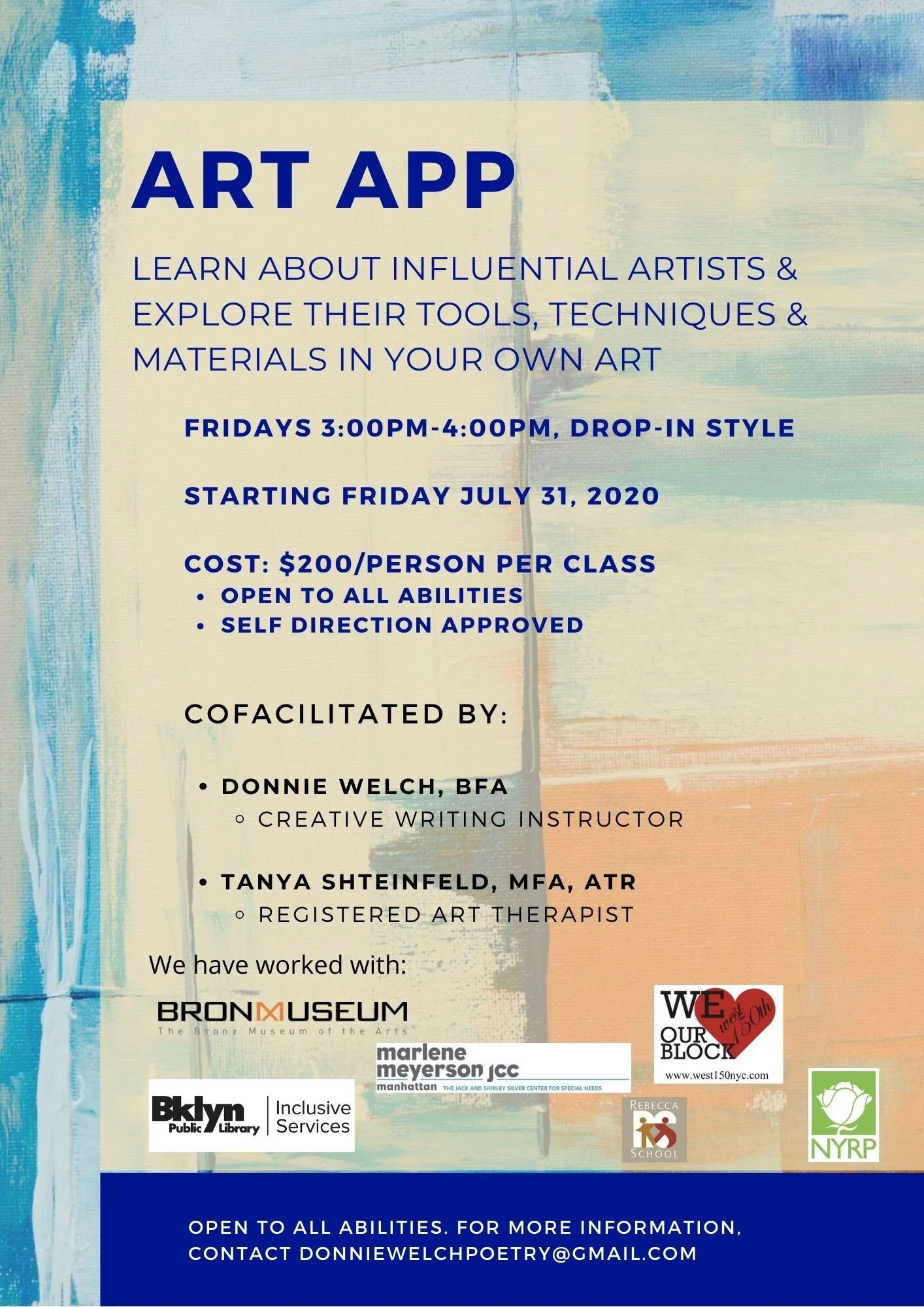
I have another community class offering! This one is Art App (or Art Appreciation) and I’m co-facilitating with my colleague Tanya Shteinfeld.

This drop-in class will walk participants through the life and careers of influential artists from all over the world and end with a guided art making activity using the artist's tools, technique, or materials. There will be an opportunity at the end of every class to share your artwork as well!

The classes are self-direction approved and run on a drop in status, so anyone is welcome whenever they can make it.

Email me at DonnieWelchPoetry[at]gmail.com for more info and see the flyer below!

Flyer for Art App Community class set against a blue and white abstract painting background

Flyer for Art App Community class set against a blue and white abstract painting background

Community Class Starting Tomorrow

Hey all, I’m hosting a virtual poetry class every Monday and Wednesday with my colleague Courtney Latter.

These workshops are specifically geared towards young adults in their early and mid twenties dealing with the changes that adult life brings.

The classes are self-direction approved and run on a drop in status, so anyone is welcome whenever they can make it.

Email me at DonnieWelchPoetry[at]gmail.com for more info and see the flyer below!


Poetry Flyer.jpg

Google Certified Teaching Artist

Listen as the PoEDtry Podcast or Watch as the PoEDtry Vlog


I recently acquired my Level 1 and Level 2 Google for Education Certifications making me a Level 2 Google Certified Educator.

While these certifications have been around for awhile and helpful to classroom teachers, I wanted to take a moment and talk about why I decided to pursue them as a teaching artist.

With COVID-19 I lost most of my gigs, but the ones that continued moved to virtual classrooms. I had a small amount of experience leading webinars and chats, but these were often with adults or college students as guest lectures or trainings, not as classes with students. Since the rhythm and movement work I do in person didn’t translate particularly well, keeping a beat over video chat leads to a lot of lag, I wanted to find new ideas for engagement in these digital spaces.

The Level 1 certificate was pretty straightforward and an overview of all the Google tools. When I say all I mean all so I recommend going through the practices Google has set up. I was given this tip before starting and it helped me a lot. That said, anyone who regularly uses Google’s more popular products: Gmail, Drive, YouTube, Docs, should be able to quite quickly navigate the practice and pass the test.

Level 2 was a bit trickier, this went deeper into all the program functions from level 1, but also focused heavily on application and implementation. I was particularly inspired by Google Lit Trips, an idea created by a retired English teacher which uses,

 “Google Earth to create immersive 3D literary field trips where students virtually become traveling companions with characters in stories commonly taught in grades kindergarten through high school.”   -

https://www.googlelittrips.org/aboutGLTGE/aboutGLT.php

I created a short Lit Trip of my own for a workshop. We were working on the Limerick form so I organized a Limerick Poem Tour  taking students across the ocean to Limerick Ireland and then to the birthplace of Edward Lear whose works we were studying.

There are similar certificates offered by Microsoft and Apple, but I was attracted by Google’s prices with $10 for the Level 1 test and $25 for Level 2. If you’re a teacher, it probably makes the most sense to pursue a certification with whoever your school or institution is using, and hopefully you can get your school to pay for it. But if you’re independent like me, Google’s is the cheapest option and the skills generalize across the platforms. While all three companies have their proprietary technology and branded app names, the use of them and their applications for learning are the same.The pros and cons of video chatting in a blended learning classroom are going to be the same pros and cons on Microsoft Teams or Google Hangouts.

On a more pragmatic, and frankly selfish, note I also wanted these certificates as resume builders. Virtual learning doesn’t seem to be going anywhere anytime soon, even with the debate to reopen schools raging on, so I wanted to set myself apart. The talent pool for teaching artists is pretty deep here in New York and while many of us have our niche and expertise, the virtual platform levels that a bit. If future learning is going to become increasing digital, then I want schools and institutions to know I can rise to the challenge.

I urge my colleagues and fellow teaching artist to do the same. If we are going to survive as field we need to adapt. It’s tempting to bemoan virtual learning and I certainly did a good amount of that myself. It isn’t and will never be the same as teaching in person.

However, we owe it to the students we work with to find a new kind of joy in these virtual spaces and, let’s be real, there’s a lot of funny stuff on the internet. Joy is certainly more than a meme, but we’ve got to start somewhere. Once we find that joy and share it in these digital sessions the connections, engagement, and learning will happen, even if it’s a bit different than how we’re used to in person.

The first step in making all this happen is mastering the tools we have at our disposal.

Tell the NYC Council #ArtsAreEssential

Action Item

Follow link above to a phone bank and script for your council member. Can also find info to email, tweet, and otherwise reach out.


Listen as the PoEDtry Podcast or Watch on YouTube

The New York City budget deadline is tomorrow June 30th 2020 and there are a lot of things at stake, but education is one of them. There were recent lay offs of school counselors while $450 million were promised to school police, no real measures or monies set aside for teacher and student safety in the potential September re-opening, and an existential threat to arts education and the jobs of teaching artists throughout the city.

It’s this final point which I want to call attention to as it’s the one I speak to most directly.

Currently, there is $15.5 million for “Expanded Arts Instruction” on the line in the 2020/2021 city budget. This money funds partnerships between the New York City Department of Education & Cultural Organizations. These partnerships enable teaching artists such as myself to come and run programs for students.

While teaching artists might sound like an extra enrichment for those unfamiliar with our work, I assure you we are not. It’s true, we are there specifically for art and, even more specifically, for the art we practice. However, it’s our expertise and outsider status (so to speak) that gives us the ability to work differently, though in conjunction with, classroom teachers. We can hone in and push the artistry, confidence, and self-advocacy skills of our students. For example, in my work, I’m able to center my poetry on voice and helping students discover, develop, and exercise their voice because I’m running poetry workshops, not an English-Language Arts class with an assessment at the end.

Img: An advocacy post using dark blue contrasted against teal and bright white text to share a statistic about arts education. “4 out of 5 young adults who’ve had arts-rich experiences are more likely to vote or participate in a political campaign  …

Img: An advocacy post using dark blue contrasted against teal and bright white text to share a statistic about arts education. “4 out of 5 young adults who’ve had arts-rich experiences are more likely to vote or participate in a political campaign via Americans for the Arts”

Beyond this more abstract, social point, the loss of partnerships would leave some schools scrambling to meet the New York State Arts Learning Standards. In one elementary school where I run sessions, my semester visits make-up their art classes for the year. The classes I don’t see are taught by a kindergarten teacher doubling her time as an all-grade visual art teacher. This is unfair to her as an educator and to the students who aren’t receiving instruction from a trained arts educator.

This is not an indictment of that school or teacher who is busting their tail for students, but is a fiscal reality public schools face. I raise the point to call attention to the importance of continuing these partnerships and, to a broader point, of defunding the NYPD to better fund public education.

This broader call for equity has a resonance with the partnership funding as well. By the New York City Council’s own reasoning and research, New York public schools remain deeply segregated

New York City public schools remain some of the most segregated in the country. In New York City public schools, 74.6% of black and Hispanic students attend a school with less than 10% white students. Additionally, 34.3% of white students attend a school with more than 50% white students.

And for further research I’d suggest the Citizen’s Committee for Children of New York recent research .

The more affluent, predominately white schools will continue to have the budget, connections, and means to bring in teaching artists and facilitators. However the highest needs schools and District 75 schools ( self-contained, special education settings where I do most of my work) whose budgets are already tight rely on the grants and support from these now threatened partnerships to bring in teaching artists and deepen their arts education. Cutting this $15.5 million will effectively, end arts in many these schools. This programming loss isn’t just about paintings on refrigerators either, it has far reaching impacts on these youth, their communities, and our city.

Img: An advocacy post using dark blue contrasted against violet and bright white text to share a statistic about arts education. “Low Income students highly engaged in the arts are 2x as likely to graduate from college than peers with no arts educat…

Img: An advocacy post using dark blue contrasted against violet and bright white text to share a statistic about arts education. “Low Income students highly engaged in the arts are 2x as likely to graduate from college than peers with no arts education via Americans for the Arts”

I ask you once again, please, please take two minutes to contact your City Council Member and tell them Arts Are Essential. If you’re not in New York, you can help by sharing this information publicly on social media or privately with any New Yorkers you know.

And, if you’re reading this after June 30th 2020 or July 1st 2020 (when revisions may be submitted) then you can still contact your officials to tell them thank you for protecting equitable arts education or to tell them where your vote will be going in next November.

Img: An advocacy post using dark blue contrasted against teal and bright white text to share a quote about arts education. “For the sake of our young people and our neighborhoods, for the sake of equity, for the sake of New York’s future, we ask tha…

Img: An advocacy post using dark blue contrasted against teal and bright white text to share a quote about arts education. “For the sake of our young people and our neighborhoods, for the sake of equity, for the sake of New York’s future, we ask that arts education in the schools be a funding priority. via Thelma Golden Dir & Chief Curator of the Studio Museum in Harlem”

Images via the Arts in Education Roundtable #ArtsAreEssential Toolkit

This post is deeply indebted to the organizing & advocacy work of Rachel Watts

Defiance: A Poet Wants to Eat the World

Listen as the PoEDtry Podcast

Watch as the PoEDtry Vlog


A poet wants to eat the world and I say, “Okay, cool!”

On a large piece of white butcher paper tapped to a window in the school’s library the poet slowly writes:

There was an old lady who swallowed the world

She tried not to barf when she swallowed the world

She swallowed the world to fill up Kelly

I don’t know why she swallowed Kelly

Perhaps she’ll burp!

We’re working on a recreation of There was an Old Lady Who Swallowed a Fly, using the scheme of the text, but changing the object that gets eaten. Kelly, in this case, is the classroom teacher.

This workshop is in a self-contained setting with young, autistic students. In this kind of setting, data driven classroom management strategies and behavioral intervention can be standard tools. But if I were to bribe (with stickers, candy, or weird fake school dollars… my schools currency was “skipper cash”) kids to edit their poetry, it wouldn’t be in their voice. Their art would become a vector for parroting my or the school’s ideas and values.

In this setting, other educators might read this poem’s structure and try to scaffold the poet into reordering it. Logically, the world shouldn’t fill up Kelly, after all Kelly is only one person and the world is massive in comparison. Or they might ask for an edit that’s less defiant.

Because, while the poem is funny to the outside viewer, during the workshop this poet was deadly serious. They were angry and hurt. The humor of this poem is our adult, observer lens shaping the reader. The emotional truth of the poem is painful.

She tried not to barf when she swallowed the world

Defiance is a well-known subject in special education with official terms like Oppositional Defiant Disorder (ODD) and staff room gossip following kids from grade to grade. It’s deemed a bad thing. I’m not sure it is. I am well aware of the challenges of working with students with ODD labels. I am not attempting to belittle the amount of adapting and patience required in that work or talk down about the efforts of paras, teacher’s assistants, and teachers doing that work.

What I am saying is that defiance is a life skill.

I say this acknowledging my privilege and hear that in a world where Black children are being killed for simply walking through neighborhoods or carrying a toy gun the concept is rightly frightening to educators and caregivers.

But teaching compliance is not setting students up for a successful, independent life.

We’ve seen over and over again footage that confirms compliance doesn’t ensure safety if you’re anything besides a cis-het, able-bodied white man. We have proof through the present that compliance only further entrenches whiteness and white power. Yet it remains a standard our students are held to in the name of development and management. But development by what metric? Who developed them? To what end? And what do our ideas of a “managed classroom” have history in? These are questions for self-reflection that I leave to you as I’m still finding my own answers.

We find ourselves touched by Maurice Sendak’s Wild Things shouting “We’ll eat you up! We love you so!” But there’s nothing cutsey about that. It’s aggressive. It’s defiant. It’s honestly not much different than what the poet in this workshop is saying and yet we’ve collectively agreed to recognize and find the love in Sendak’s character while problematizing what so many young folx are trying to communicate.

The power dynamics at play between the poet and their teacher may have necessitated Kelly getting eaten. Maybe it was a bad day. Maybe breakfast sucked. Maybe something out of Kelly’s control happened, a sickness, a death, a sorrow that’s difficult to share. As it turns out, the poet was told they’re moving schools next year: “Oh please don’t go!”

Knowing that, there’s a touching beauty to the order of this poet’s work: the world eaten after Kelly rather than before. Poetry is a genre where one person can, in fact, be your whole world. This metaphor holds an emotional truth in a poem that defies the logic of the larger, pragmatic world.

A teacher might just be a student's world. They might be the most consistent care-giver they have. That love and care are overwhelming, all-encompassing feelings. In this same sense, a miscommunication or disappointment can feel like being swallowed up: isolated, dark, disoriented.

If this poet didn’t have a space and place to share without fear of being made compliant, we (myself, co-facilitators, and school therapists) might have never known something deeply touching and emotionally complex was at play. We might have been on the receiving end of their frustration and have later seen a moment of aggression to track. Or, worse still, might have seen nothing at all and left the poet unheard and their feelings unresolved. But now, there’s an opportunity to support this defiance and nurture it into a moment of self-actualization for the poet and self-discovery for us as educators and our practice.

So when a poet wants to eat the world I say, “Okay, cool! Then what?”

Because defiance needs to be celebrated, refined, and honed so that it can become a strength.

Because I want the poets who leave my workshops to have the skills to shape defiance into thoughtful speech and purposeful action, channeling it in ways that will help them navigate the world and all its inequities.

Because if you’re going to eat this world, you’d better be bold enough to make a new one

Because we could sure use one of those right about now.  

A Hiatus… of sorts

This is a blog about not blogging, for a little while anyway.

That’s not to say I’m taking the blog down or even that I’m going to stop entirely, just that I’m not going to be writing a post every week.

I’ve made this decision for a few reasons:

One is that my time is becomingly increasingly squeeze and while I wish I could keep doing all the things I want… I cannot. The weekly blog was the aspect of my media plan receiving the least attention and traffic but it demanded a large chunk of my time (second behind the Friday videos) so pragmatically it was the part that had to go.

I also feel like I had started posting some fluffy pieces and you, readers, do not deserve fluff! As I was sitting down today and looking at the list of topics I’d drafted, I realized all them were kind of clickbait, SEO driving topics that I wasn’t excited to share and that you could probably find on a dozen other blogs. My goal is for this to be a source for inspiring, engaging content that you can use to make your creative spaces more inclusive and accessible.

Lastly, I have a lot of exciting writing projects from picture books to academic articles with colleagues to sitting down and finishing a second draft of a full-length education book. I’ve been putting a lot of these off in the name of creating new blogs and I think that’s a disservice to both myself and you. The blog was an important outlet for me to share my ideas initially, but now I’m ready to give you more to dig into than three to five minute reads.

All that said, I’ll still blog cool lesson plans and share whatever small business tips are working for me. I’ll write up long form reflections on big projects, like a post about my 2020 Bronx Museum partnerships once that finishes, as well as put up a thought piece or two, but just not every week. When I do post, it’ll still be on Mondays and I’ll still share across my media platforms, so it’ll be as easy to find as always.

If you want to stay update with all my goings on, I have a monthly newsletter where I’ll share the blogs I’ve written that month.

I have a good feeling about this change!

Edupreneur: Free Tax Resources for Freelancers

I’ve always done my own taxes and done them with a fair amount of confidence, but this year became more complex for me and I had to go find resources and professional help. While finding the right tax professional is a personal choice, I wanted to share some of the resources I used which informed my decision making and documenting preparing.

Unsolicited Advice: I wouldn’t wait to file this year, get it done early and give yourself plenty of time to pivot!

First up is a link to a recorded webinar put on by the NYC Arts in Education Roundtable. The webinar is led by Dominic Comperatore, professional actor, and founder of Empire Tax Prep who specializes in preparing taxes for artists and teaching artists. I highly recommend watching this recording and taking notes. It’s a thorough run down from basics to specifics of what you need to do as an artist to prepare you for tax season and protect yourself financially in the future.

Another source for video training is LinkedIn Learning which is accessible by upgrading to a LinkedIn Premium account. I list this as free because (I believe!) your first month of premium is offered as a free trial account. LinkedIn recently purchased Lynda so there’s a huge amount of classes, just make sure you cancel before your account is charged. Specific to this topic, there are numerous courses on taxes, accounting, small business finance, and even a Finance Foundations for Soloprenuers class which includes a chapter on tax preparation.

If video learning isn’t necessarily your style there’s a free Bookkeeping course available from the “Accounting Coach. As with many of these programs, there’ll be a lot of pop-up opportunities to purchase the pro-version of the courses as a well as a certificate that’s behind a pay wall, but the knowledge itself is accessible for all and the course work includes word scrambles, crossword puzzles, and other engaging activities that don’t feel like homework.

Finally, check out your local libraries, community centers, or small business associations! Usually during tax season these places bring professionals for conversations and presentations on taxes. While these can be broader in focus, they’re still insightful and it can be nice to feel apart of a community and not so alone in dealing with these nuances.